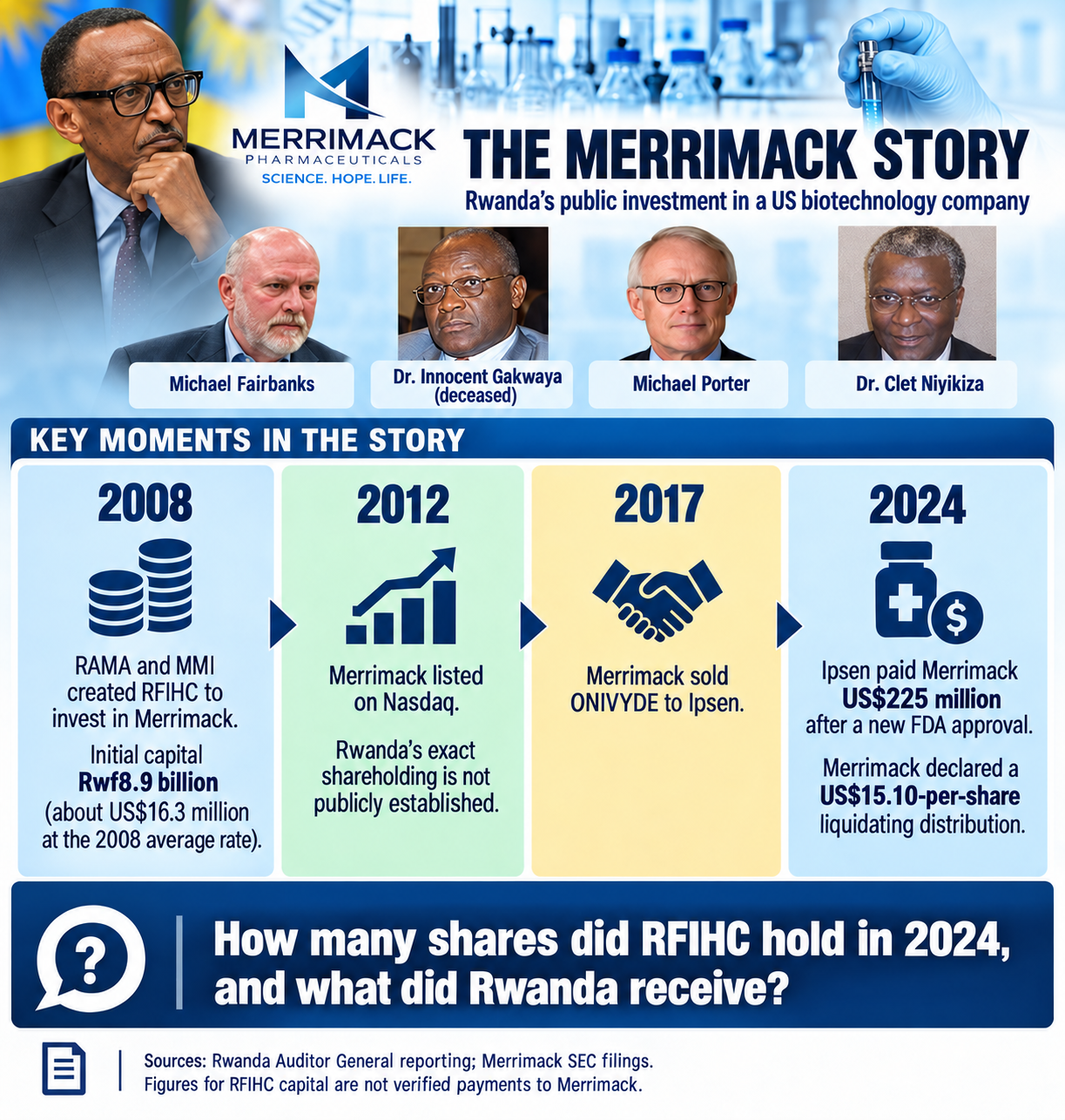
In 2008, two Rwandan health insurers—RAMA and Military Medical Insurance (MMI)—created the Rwanda Foreign Investment Holding Company (RFIHC) to invest in Merrimack Pharmaceuticals, a United States biotechnology company. RFIHC’s initial share capital was Rwf8.9 billion, approximately US$16.3 million at the 2008 average exchange rate. It later rose to Rwf10.1 billion. By 2015, the Rwanda Social Security Board (RSSB), which absorbed RAMA, held 94.5 percent of RFIHC; MMI held 5.5 percent. RFIHC’s share capital is not necessarily the amount it paid for Merrimack shares.
WHAT WAS THE OUTCOME?
During parliamentary scrutiny in 2021, officials reported that approximately Rwf9.5 billion had been invested in RFIHC—roughly US$13.2 million at the 2015 average exchange rate—while it had recorded about Rwf1.5 billion in profits by 2018, roughly US$1.7 million at the 2018 average rate. These are illustrative currency conversions, not verified dollar amounts transferred or received. Parliamentarians also questioned the company’s address and financial reporting. Recorded profit alone does not establish the investment’s final return.
Merrimack sold the cancer drug ONIVYDE to Ipsen in 2017. A later regulatory approval triggered a US$225 million payment to Merrimack in March 2024. Shareholders subsequently approved a dissolution plan with an initial distribution of US$15.10 per share. Did RFIHC still own Merrimack shares on the relevant dates? If so, how much did it receive? Merrimack’s payment cannot be counted as Rwanda’s return without the share and cash records.
WHO APPEARS IN THE STORY?
RAMA and MMI were the original institutional investors. The late Dr. Innocent Gakwaya, who headed RAMA, was President Paul Kagame’s brother-in-law, according to Dr. Theogene Rudasingwa’s firsthand account. Michael Fairbanks, an adviser to Kagame, has described himself as an early Merrimack investor. Harvard professor Michael Porter advised Rwanda and had a relationship with Merrimack. Dr. Clet Niyikiza, a member of Kagame’s Presidential Advisory Council, joined Merrimack in 2009. These overlapping roles warrant examination; they do not, by themselves, establish improper conduct.
QUESTIONS STILL UNANSWERED
Who proposed and approved the investment at RAMA and MMI? What valuation and risk assessment did their boards consider?
What were RFIHC’s exact Merrimack holdings, purchase prices, sales and ownership on the 2024 dividend record date?
How much cash ultimately returned to RSSB and MMI, after costs, taxes and exchange-rate effects? Where is it recorded in their audited accounts?
Were relevant financial, advisory and family relationships disclosed to the approving boards? Were any recusals required or made?
What scientific capacity, research partnership, medicine access or other measurable benefit accrued in Rwanda, beyond any financial return?
The public record supports neither a verdict of fraud nor a confident claim of investment success. It supports a request for a complete transaction ledger: approvals, share records, audited valuations, sales and receipts. Rwandans whose contributions financed this venture deserve to know what was risked, what was learned and what came home.